
21.09.2019
Porcelain course at the ceramics school "La Meridiana" in Italy
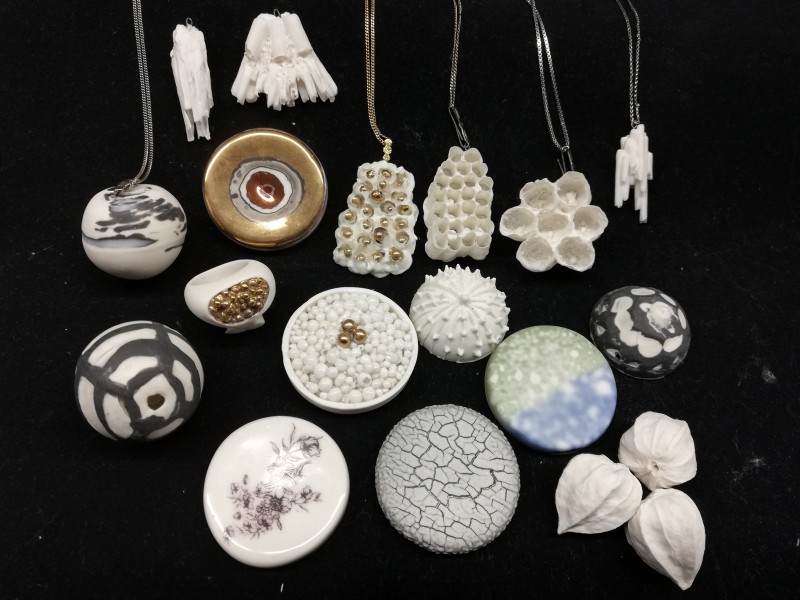
His workshops are very varied. I decided to get to know further complicated techniques and unusual surface treatments for refined jewellery made of fine porcelain. The focus was on slip casting - pouring fine liquid porcelain, also in different colours, layer by layer into plaster moulds that we had previously made ourselves under his guidance. For example geometric shapes, but also organic ones created with the help of natural materials.
We filled the plaster moulds we had made ourselves with porcelain slip, let it dry for about 3-6 minutes depending on the time specified and then, amusingly, blew the rest out again with a drinking straw. After drying we took our small, delicate works of art in porcelain out of the moulds and could then work on them further with various techniques. We embellished and refined them, quite individually, by scoring or cutting, with metal salts, dry glazes, craquelure effects, precious metals and so on.
Despite the concentrated work, the breaks left time for exchange and for getting to know one another well. It stood me in good stead that I had prepared thoroughly in advance for meeting artists from such different countries and cultures. Every participant received from me information material about my home city of Dresden and the Meissen porcelain manufactory, which I had brought from home. I told them about the many historical sights and art treasures in Dresden and the surrounding area. There was particular interest in the invention of the first "European porcelain" by Johann Friedrich Böttger at the Albrechtsburg in Meissen.
The subject of porcelain was ever-present, and so in the evenings too, in convivial company over delicious Mediterranean food and many a bottle of Tuscan wine, we exchanged our experiences and visions, also on the subject of the "European community", in a friendly atmosphere of mutual recognition and respect. We agreed that everyone can learn from everyone else, and so we have been in close contact ever since.
The most exciting part was experimenting with various natural materials! What, for example, do cigarette paper, cigarette filters and crisps have to do with porcelain??? Anyone who takes part in my lessons, and soon in a porcelain workshop at the Musik-, Tanz- und Kunstschule Bannewitz or further afield, can find out.
The training helped me a great deal to get to know the special features of the ceramic material "porcelain" in still greater depth, to understand its complicated, specific handling and processing better in context and to draw the appropriate conclusions for my future teaching.
The specialist knowledge I have newly acquired, with the practical abilities and skills in the art technique described, is also an important basis for an interesting methodical and didactic design of my lessons, which thereby gain considerably in quality.
By making the courses more attractive, we expect new course participants and greater awareness of our school. I will report on my training to my colleagues at the MTK in staff meetings and gatherings and will be very happy to offer interdisciplinary suggestions.
As the course was held exclusively in English, I was also able to consolidate and extend my knowledge in that respect.
There are no comparable courses in our region, so that I can actively support the project goal of finding new unique features for our school, also beyond the region.
I am already looking forward to passing on new and interesting possibilities of ceramic design to everyone with a curious interest in art.
Gudrun Sochorik